
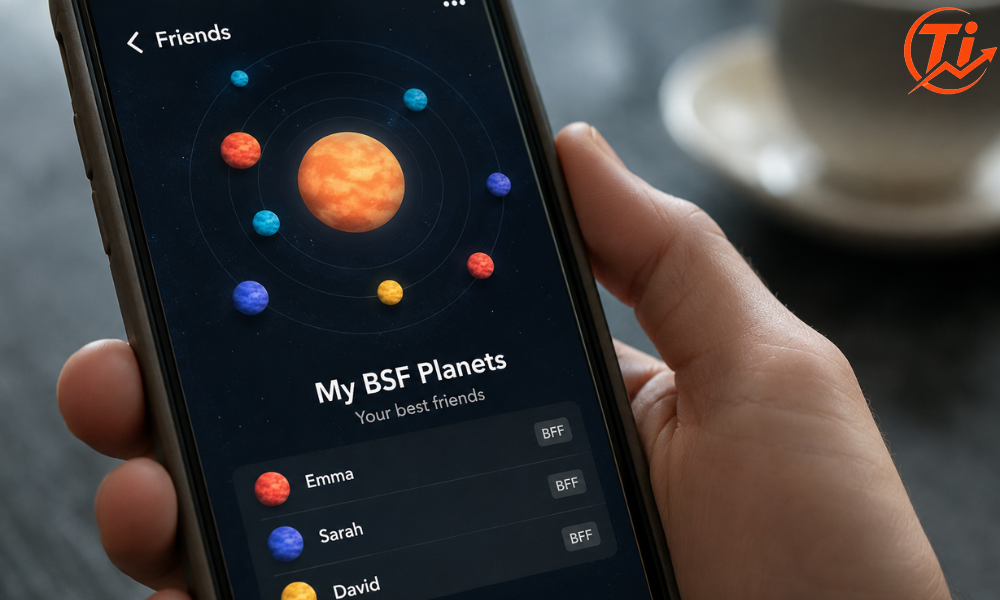
The first time a little red planet showed up next to my best friend’s name on Snapchat, I genuinely thought something had broken. No explanation, no popup, just a tiny glowing “Mercury” badge sitting where a gold star used to be. Turns out I wasn’t confused for long, and if you landed here because the same thing happened to you, you’re about to get the full picture.
Snapchat BSF planets are part of the Friend Solar System, a Snapchat+ feature that ranks your top 8 most-interacted-with friends using planets from our solar system. Mercury is your closest friend, Neptune is your eighth closest, and the order in between follows Venus, Earth, Mars, Jupiter, Saturn, and Uranus. The ranking is based on how often you snap, chat, and reply to each other’s stories, and it updates automatically as your interactions change.
That’s the short version. Now let’s get into what each planet actually represents, how the ranking gets calculated, and a few things almost nobody explains clearly, like what happens when only one of you pays for Snapchat+.
What Does BSF Mean on Snapchat?
BSF stands for Best Friends, and on Snapchat it refers to the small group of people you interact with the most on the app. Before planets existed, this was shown through gold stars, hearts, and other emoji badges next to a friend’s name. The planet system is essentially a visual upgrade of that same idea, wrapped inside the paid Snapchat+ subscription.
If you’ve ever tapped a friend’s profile and seen a small glowing planet icon sitting near their name, that’s their spot in your personal “solar system,” or if it’s on your own profile, it’s showing where you rank in someone else’s.
Snapchat BSF Planets Order (Full List)
Here’s the complete order, from your number one friend to your number eight.
| Rank | Planet | Meaning | Typical Visual |
|---|---|---|---|
| #1 | Mercury | Your closest, most interacted-with friend | Bright red planet, multiple red hearts, sparkle effect |
| #2 | Venus | Your second closest friend | Soft beige or pinkish planet with multi-colored hearts |
| #3 | Earth | Your third closest friend | Blue and green planet |
| #4 | Mars | Your fourth closest friend | Reddish-orange planet |
| #5 | Jupiter | Your fifth closest friend | Larger, banded planet |
| #6 | Saturn | Your sixth closest friend | Ringed planet |
| #7 | Uranus | Your seventh closest friend | Pale blue-green planet |
| #8 | Neptune | Your eighth closest friend | Deep blue planet, minimal glow |
A pattern worth noticing here: this mirrors the actual order of planets from the sun outward. You’re the sun in the middle, and the closer someone orbits you, the more you’re snapping, chatting, and replying to their stories.
One detail that trips people up is Mercury specifically. Because it’s the closest planet to the sun in real astronomy, it also carries the most visual flair on Snapchat, usually shown with several hearts and a small glow around your friend’s Bitmoji. Getting Mercury status from someone is basically the digital equivalent of being their number one.
Neptune sits on the opposite end. If you’ve noticed a friend showing up as Neptune, it doesn’t mean the friendship is bad. It just means, out of your current top 8, they’re the one you’re interacting with least right now. Since rankings shift based on recent activity, someone can move from Neptune back toward Mercury within a couple of weeks if the conversation picks back up.
How the Snapchat Planet Ranking Actually Works
Snapchat hasn’t published an exact formula for how it weighs each type of interaction, and any guide claiming to know precise percentages is guessing. What’s more reliably observed is which factors matter and roughly how they stack up against each other.
Based on how the feature behaves in practice, these are the main inputs:
- Snap frequency. Sending and receiving actual Snaps, not just text chats, appears to carry the most weight. This is the core behavior Snapchat was built around, so it makes sense it drives the ranking the most.
- Chat consistency. Regular back-and-forth messaging matters too, especially when it’s sustained over days or weeks rather than a single burst of activity.
- Story replies and reactions. Viewing someone’s story is passive and doesn’t move the needle much, but replying to it or reacting does contribute.
- Snapstreaks. Keeping a streak alive with someone is a form of consistent daily interaction, which naturally supports a higher ranking, though a streak alone isn’t a guaranteed ticket to Mercury.
- Recency. More recent activity tends to outweigh older activity. A friend you snapped constantly with three months ago but rarely talk to now will likely have drifted toward Neptune.
What this means practically: the system rewards frequent, mutual, and recent interaction over any single big gesture. Sending one long Snap doesn’t move you up nearly as much as a week of steady back-and-forth conversation would.
How to Check Your Snapchat BSF Planet
If you want to see where you rank in a friend’s solar system, or where they rank in yours, here’s the process.
- Open Snapchat and go to your friend’s profile.
- Look below their display name for a small badge. A “Best Friend” badge means you’re both in each other’s top 8. A “Friend” badge means you’re in their top 8, but they aren’t in yours (or the reverse).
- Tap the badge if one appears.
- Your specific planet ranking will be revealed, showing exactly where you land in that person’s Friend Solar System.
Keep in mind both people generally need an active Snapchat+ subscription for the full planet visualization to appear on each other’s profiles. Without it, you may still see a best friend indicator, just not the planet graphic itself.
Old Best Friend Emojis vs the New Planets System
If you used Snapchat before this feature existed, you probably remember the emoji-based ranking system. Here’s how the two compare.
| Feature | Old Emoji System | New Planets System |
|---|---|---|
| Availability | Free for all users | Requires Snapchat+ subscription |
| Visual style | Static emojis (gold star, hearts) | Animated planet icons with Bitmoji |
| Ranking depth | Limited categories | Full ranked order, 1 through 8 |
| Symbol meaning | Yellow heart, red heart, gold star, etc. | Mercury through Neptune |
| Precision | General tiers | Specific numbered rank |
The planets system didn’t replace the emoji system entirely. Free users still see the classic gold star and heart badges. Snapchat+ subscribers get the added planet layer on top, which gives a much more granular view of exactly where they stand instead of a broad category.
What Happens If Only One of You Has Snapchat+
This is one of the more common points of confusion, and it rarely gets explained clearly. If you have Snapchat+ but your friend doesn’t, you won’t see their planet on your end and they won’t see yours either. Both people need an active subscription for the planet graphics to display on each other’s profiles.
If you cancel Snapchat+ after using the feature, the planet visuals disappear from your view, though the underlying best friend ranking (the older emoji-based system) will still function normally, since that part is free.
Is There a 9th Snapchat Planet?
Every so often a rumor circulates, usually starting on TikTok or Reddit, claiming there’s a secret ninth planet unlockable through extremely high interaction. Based on how the feature has consistently behaved since launch, there is no verified ninth planet. The system has always capped out at eight friends, matching the eight planets in our actual solar system.
The rumor likely persists because Snapchat doesn’t publish its ranking algorithm publicly. When people don’t understand exactly why their ranking changed, or they hit an app glitch that displays something unusual, it’s easy to assume there’s a hidden feature rather than a normal bug or a simple recalculation.
When Your Ranking Changes: A Word on the Emotional Side
Nobody really talks about this part, but it’s worth addressing honestly. Finding out you’re someone’s Neptune, or that a friend you thought was close to you has drifted down the list, can genuinely sting a little. It’s a strange feeling to have a friendship quantified and displayed as a number.
A few things are worth keeping in mind if that happens to you. First, the ranking only reflects app activity, specifically Snaps, chats, and story replies. It says nothing about how someone actually feels about you outside of Snapchat, and plenty of close friendships involve very little app-based communication because you talk in person, over the phone, or on other platforms instead.
Second, rankings are not mutual by default. You could be someone’s Mercury while they show up as your Mars, and that’s completely normal since each person’s solar system is built entirely around their own habits, not yours.
If a ranking shift genuinely bothers you, it’s usually more productive to just reach out to that person directly rather than reading too much into an app badge. A short “hey, we haven’t talked in a while” message tends to fix more than staring at a planet icon ever will.
Read More: https://trendinginsight.co.uk/tech-guru-wavetechglobal/
FAQs
What does BSF mean on Snapchat?
BSF stands for Best Friends. On Snapchat it refers to the small group of people, usually up to eight, that you interact with the most through Snaps, chats, and story replies.
What is the full order of Snapchat planets?
From closest to farthest: Mercury, Venus, Earth, Mars, Jupiter, Saturn, Uranus, and Neptune. Mercury represents your number one most interacted-with friend, and Neptune represents your eighth.
Do you need Snapchat+ to see planets?
Yes. The Friend Solar System, which includes the planet visuals, is exclusive to Snapchat+ subscribers. Both you and your friend generally need active subscriptions for the planets to appear.
Why did my Snapchat planet change?
Rankings update based on recent interaction levels. If you and a friend have been snapping and chatting more than usual, you’ll move closer to Mercury. If activity slows down, you’ll drift toward Neptune.
Is Snapchat planet ranking mutual between friends?
No. Each person’s solar system is based entirely on their own interaction habits. You might rank someone as your Mercury while they rank you much lower, and that’s completely normal.
Is there a 9th Snapchat planet?
No verified ninth planet exists. The system has always used exactly eight planets, matching the top 8 friends format Snapchat has used for years.
How often do Snapchat planets update?
There’s no fixed schedule Snapchat has confirmed, but rankings appear to adjust continuously based on ongoing activity rather than on a set weekly or monthly reset.
Can you see someone’s planet if they don’t have Snapchat+?
No. If either person lacks an active Snapchat+ subscription, the planet graphic won’t display on that profile, even if a general best friend badge still shows.
Final Thoughts
The Snapchat planets feature is a fun, visual way to see who you’re actually spending the most time interacting with, even if it occasionally stirs up more feelings than expected. Understanding the order, from Mercury all the way to Neptune, and knowing what actually drives the ranking makes the whole thing a lot less mysterious.
If you’re a Snapchat+ subscriber, take a minute to check your own Friend Solar System and see who’s currently sitting closest to your sun. And if someone you care about shows up further out than you’d like, the fix is usually simpler than the app makes it look: just send them a Snap.