
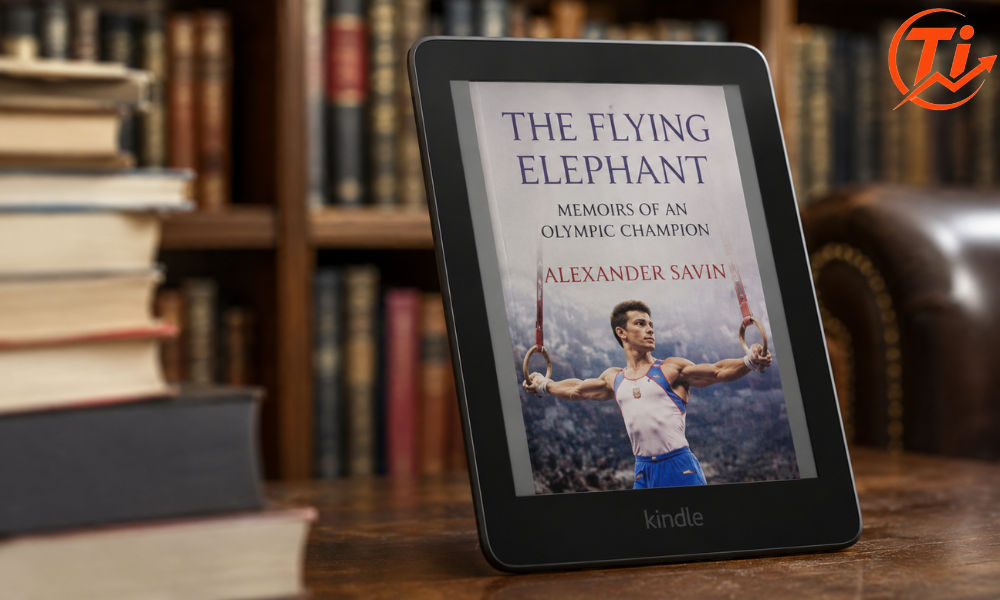
Most sports memoirs open with a highlight reel. This one opens with a much harder question: what does it actually cost to become the best in the world at something, and was it worth it? The Flying Elephant: Memoirs of an Olympic Champion, the Kindle edition written by Alexander Savin, spends most of its 514 pages answering that question instead of simply listing medals.
If you’ve come across the title while browsing the Kindle Store and want to know what you’re actually getting before you tap “buy,” here’s a straightforward answer, not a marketing pitch.
The Flying Elephant is a 514 page Kindle memoir by Alexander Savin, a Soviet volleyball middle blocker who won silver at the 1976 Montreal Olympics and gold at the 1980 Moscow Olympics. The book covers his rise through Soviet volleyball, his years with CSKA Moscow and the USSR national team, his transition into coaching, and includes over 240 rare photographs. It’s available on Kindle and, in some regions, through Kindle Unlimited.
Who Is Alexander Savin?
Alexander Savin was born on July 1, 1957, in Taganrog, a city in Russia’s Rostov region. He played as a middle blocker for the Soviet Union’s national volleyball team from 1975 to 1986, a stretch that lined up almost perfectly with the peak years of Soviet volleyball dominance.
His Olympic record is the kind that gets a player remembered for decades. He won silver at the 1976 Montreal Olympics, playing in all five of the team’s matches, then came back four years later and won gold at the 1980 Moscow Olympics, playing all six matches. Beyond the Olympics, he picked up multiple World League championship titles and, by most counts, around eleven major international gold medals over his career.
In 2010, Savin was inducted into the International Volleyball Hall of Fame, a recognition reserved for players who shaped the sport at an international level. After retiring from competitive play, he moved into coaching and mentorship, which is part of why the second half of the memoir reads less like a highlight reel and more like a meditation on what he learned by teaching younger players.
Why “The Flying Elephant”?
The nickname didn’t come from a teammate or a Soviet sportswriter. It was given to Savin by the Italian sports publication La Gazzetta dello Sport, and it’s built on a contrast rather than a compliment in the usual sense. Savin was a big, physically imposing player, the kind you’d expect to move slowly. Instead, he jumped and moved with a kind of agility that looked out of place for someone his size.
That contrast, size paired with unexpected lightness on court, is the whole joke behind the name, and Savin leaned into it rather than shrugging it off. The title of the memoir isn’t just a nod to that nickname either. Throughout the book, it doubles as a metaphor for the larger idea that big, seemingly impossible goals can be reached through persistence rather than raw natural gifts alone.
What’s Actually Inside the Memoir
This is where a lot of coverage of the book stays vague, so it’s worth being specific. Based on the structure of the memoir and its marketing copy, here’s what readers can expect to find across its chapters:
- Early years in Taganrog and how Savin first got into volleyball as a teenager
- Training and development during his rise through Soviet club and national programs, including his time with CSKA Moscow
- The 1976 Montreal Olympics, where the Soviet team took silver, and what that loss meant to a young player
- The 1980 Moscow Olympics, told from the unusual position of competing for gold on home soil
- Life inside the USSR national team, covering team dynamics, rivalries, and the day-to-day discipline required to stay at that level for over a decade
- Retirement and the shift into coaching, including reflections on mentoring the next generation of players
- Portraits of teammates and mentors, some of whom the book specifically tries to bring back into the historical record after being largely forgotten
- Over 240 photographs pulled from private family collections and public archives, spanning five decades of volleyball history
That last point matters more than it sounds. A lot of sports memoirs mention photos as an afterthought. Here, the photo collection is treated as part of the historical record, not just an illustration of the text.
Kindle Edition Details
If you’re deciding whether to buy or borrow, the practical specs matter as much as the story. Here’s what’s confirmed about the English Kindle edition:
| Detail | Information |
| Format | Kindle eBook |
| Length | 514 pages |
| File size | Approximately 68.8 MB (largely due to the photo content) |
| Language | English (translated edition) |
| Kindle Unlimited | Available in some regions, subject to change |
| Author | Alexander Savin |
| Contributors | Andrei Savine (Editor, Translator), Julia Savine (Editor), Peter Murphy (Introduction), Alfredo Cabero (Translator) |
The contributor list is worth a second look, since most coverage of this book skips it entirely. Andrei Savine, Alexander’s brother, led the English translation as part of what reads like a genuine family project rather than an outsourced commercial translation. Julia Savine worked as an editor alongside him, Alfredo Cabero contributed as a second translator, and Peter Murphy wrote the introduction. That combination explains why the English version reads in a personal, first-person voice rather than the flatter tone you sometimes get in translated memoirs. It also means the book carries a level of direct family involvement in how Savin’s story gets told, which is unusual for a sports memoir of this scale.
Because the file is large, mostly due to the volume of photographs, it’s worth being on WiFi when you download it rather than relying on mobile data. If you’re using X-Ray on your Kindle device, it can help you keep track of names, teams, and locations as they come up throughout the book.
Who This Book Is For
Not every reader interested in Olympic history will love this book, and that’s worth saying plainly rather than dancing around it. It tends to work best for:
- Volleyball fans who want the history behind the Soviet program’s golden era, not just modern highlights
- Coaches and athletes looking for insight into long-term discipline and team dynamics rather than motivational quotes
- Readers of sports memoirs who prefer reflection and emotional honesty over a straightforward victory narrative
- Anyone specifically interested in Cold War era Olympic sport and how athletes on both sides experienced that period
- People who care about historical photography as much as the written story
It’s less likely to land well with readers who want a fast, highlight-driven read. The pacing leans reflective, and some sections spend more time on doubt, pressure, and the cost of competing than on the wins themselves. That’s a deliberate choice in how the memoir is built, not a flaw, but it does mean the audience for it is narrower than a typical “inspirational sports story.”
Is It Worth Reading?
The honest answer depends on what you’re looking for. If you want a book that treats an athlete’s career as a series of trophies, this isn’t it, and Savin seems to know that. The strongest parts of the memoir aren’t the medal moments. They’re the quieter observations about teammates, about the pressure of representing a national program, and about what happens to your identity once the competing stops.
The tradeoff is pacing. Because the book resists turning every chapter into a motivational lesson, some sections move slower than readers used to conventional sports biographies might expect. If you’re patient with that style, the payoff is a portrait that feels considerably more honest than most Olympic memoirs manage. If you’re after a quick, punchy read, this may test your patience in places.
On balance, for readers genuinely interested in Soviet sports history, volleyball, or the psychology of elite competition, it holds up well. For casual readers looking for a light beach read, it’s probably not the right fit.
Read More: https://trendinginsight.co.uk/timothy-shamaly/
FAQs
Who is Alexander Savin?
Alexander Savin is a former Soviet volleyball player born on July 1, 1957, in Taganrog, Russia. He played middle blocker for the USSR national team from 1975 to 1986 and won Olympic silver in 1976 and gold in 1980.
What is The Flying Elephant memoir about?
It’s Savin’s first-person account of his volleyball career, covering his early training, his Olympic campaigns, his years with CSKA Moscow and the USSR national team, and his later work as a coach and mentor.
Why is Alexander Savin nicknamed “The Flying Elephant”?
The nickname came from the Italian publication La Gazzetta dello Sport. It reflects the contrast between his large physical build and the surprising agility and jumping ability he showed on court.
Is The Flying Elephant available on Kindle Unlimited?
In some regions, yes. Availability through Kindle Unlimited can vary by country, so it’s worth checking eligibility in the Kindle Store before assuming it’s included with your subscription.
How many pages is The Flying Elephant Kindle edition?
The English Kindle edition runs 514 pages and includes over 240 photographs, which contributes to a file size of roughly 68.8 MB.
Who translated The Flying Elephant into English?
The English translation was led by Andrei Savine, Alexander’s brother, with Julia Savine as editor and Alfredo Cabero as a second translator. Peter Murphy wrote the introduction.
Is Alexander Savin in the Volleyball Hall of Fame?
Yes. He was inducted into the International Volleyball Hall of Fame in 2010, recognizing his career with the USSR national team and his broader impact on the sport.
Is The Flying Elephant worth reading?
For readers interested in Soviet sports history, volleyball, or the psychological side of elite competition, it’s a rewarding and unusually honest read. Readers looking for a fast-paced, victory-focused sports story may find the pacing slower than expected.
Final Thoughts
The Flying Elephant isn’t trying to convince you that Alexander Savin was a great player. His Olympic record already does that. What the memoir sets out to do instead is explain what it actually took to get there and to stay there for over a decade, and it mostly succeeds by resisting the urge to smooth over the harder parts.
If that kind of honest, reflective sports memoir is what you’re after, the Kindle edition is easy to access, reasonably priced through Kindle Unlimited where available, and worth the read. If you’re deciding right now, checking your regional Kindle Unlimited eligibility first is the quickest way to know whether this one costs you anything but time.