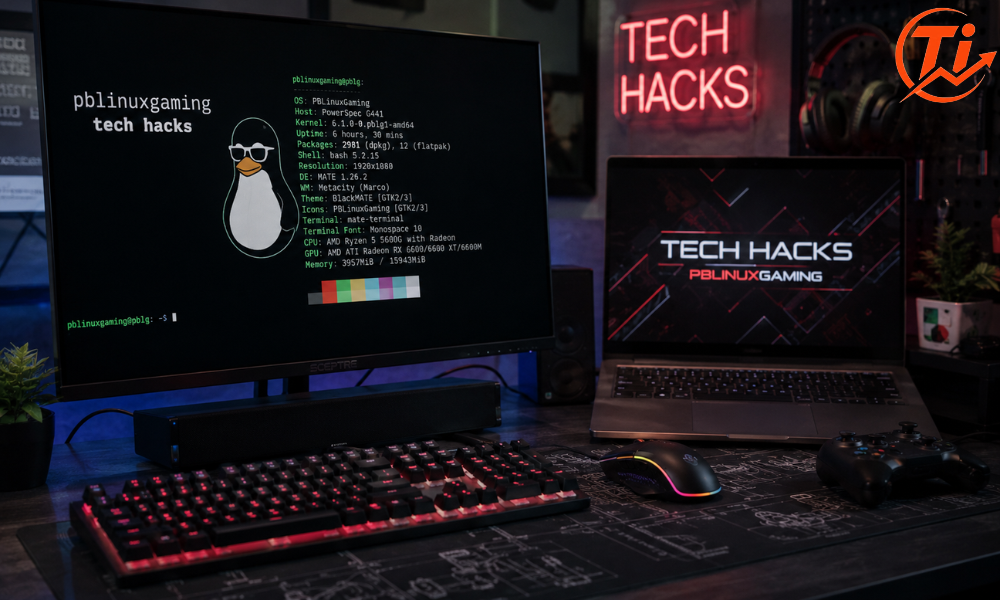
If you’ve spent an evening chasing frame drops instead of actually playing your game, you already know that Linux gaming rewards people who understand their tools. This is what I’ve learned about tech hacks pblinuxgaming enthusiasts actually use, tested on my own desktop (Ryzen 5 7600, RX 7600, Fedora 41) and a Steam Deck, not copied from a spec sheet.
What Is Tech Hacks PBLinuxGaming?
Tech hacks pblinuxgaming refers to the practical tweaks, tools, and configuration changes that improve gaming performance and compatibility on Linux. That covers everything from choosing the right kernel and enabling GameMode, to setting up MangoHud for performance monitoring and picking the correct Proton version for a given title. None of it requires new hardware. Most of it takes less than twenty minutes to set up.
Getting Your Baseline: MangoHud First
Before changing anything, measure what you actually have. MangoHud is a performance overlay that shows:
- FPS (current, average, 1% low, 0.1% low)
- Frame time in milliseconds
- CPU and GPU usage, clock speed, and temperature
- VRAM and RAM usage
- Battery percentage on handhelds like the Steam Deck
Install it first, then run your game with it enabled so you have a real “before” number. Guessing whether a fix worked wastes more time than the fix itself.
Ubuntu / Pop!_OS:
sudo apt update
sudo apt install mangohud
Fedora:
sudo dnf install mangohud
Arch Linux:
sudo pacman -S mangohud
To use it with a Steam game, right click the game in your library, go to Properties, and set the launch options to:
MANGOHUD=1 %command%
I keep MangoHud running by default on every game now. It costs almost nothing in performance and it turns “this feels laggy” into an actual number you can act on.
Enabling GameMode for a Free Performance Bump
GameMode, created by Feral Interactive, temporarily applies a set of system optimizations while a game is running: it can request a performance CPU governor, adjust I/O priority, and apply GPU-specific tweaks depending on your hardware. It reverts everything the moment the game closes, so there’s no risk of leaving your system in a weird state.
Install on Ubuntu / Pop!_OS:
sudo apt install gamemode
Install on Fedora:
sudo dnf install gamemode
Install on Arch Linux:
sudo pacman -S gamemode
Add it to your Steam launch options alongside MangoHud like this:
gamemoderun MANGOHUD=1 %command%
On my system, GameMode alone added a small but consistent frame rate improvement in CPU-bound titles. It’s not a miracle fix, but it’s free performance you’re leaving on the table if you skip it.
Proton, Proton GE, and Proton Experimental: What Actually Differs
This is the part most articles get vague about, so here’s a straightforward comparison.
| Version | Source | Best for | Update frequency | Stability |
| Proton (stable) | Valve | Older, well-tested titles | Slower, tied to Steam updates | Highest |
| Proton Experimental | Valve | New releases, anti-cheat titles | Frequent, rolling | Moderate |
| Proton GE | Glorious Eggroll (community) | Titles needing extra patches, mods, or codecs | Frequent, independent releases | Varies by game |
A practical rule I follow: start with stable Proton for anything that’s been out a while. If a brand-new release has launch issues, try Proton Experimental first. If a specific game needs a patch that hasn’t reached official Proton yet (this comes up a lot with modded titles or unusual anti-cheat setups), Proton GE is worth installing through a tool like ProtonUp-Qt.
Fixing Stutter and Shader Compilation Lag
Stutter on Linux gaming is usually one of a few specific causes, and it’s worth ruling them out in order rather than guessing:
- Shader compilation stutter happens the first time you encounter new visual effects in a game. Enable Vulkan’s async shader compilation if the game supports it, and consider pre-caching shaders where the game or Proton version allows it.
- CPU governor set to powersave on desktops caps your clock speeds unnecessarily. Switching to “performance” mode, which GameMode does automatically, often resolves this.
- VRAM overflow shows up as sudden frame time spikes rather than a steady low FPS. Lowering texture quality one notch usually fixes it faster than any other setting.
- Background compositor effects on some desktop environments compete for GPU resources. Disabling compositing while gaming, or using a lightweight window manager, frees up headroom.
- Outdated GPU drivers cause more stutter on Linux than people expect, especially with NVIDIA’s proprietary driver. Keeping it current matters more than almost any other single fix here.
A Quick Decision Flow for Bottlenecks
Open MangoHud and check usage while your FPS drops:
- If GPU usage is near 100% and CPU usage is moderate, you have a GPU bottleneck. Lower resolution or graphics settings.
- If CPU usage is maxed on one or two cores while GPU usage is lower, you have a CPU bottleneck. This is common in simulation and strategy games regardless of platform.
- If VRAM usage is at its limit and frame time spikes are frequent, you have a memory bottleneck. Lower texture settings first.
- If temperatures climb steadily alongside dropping clock speeds, you’re dealing with thermal throttling, not a software problem. Check your cooling and case airflow.
- If frame rate is fine but the game refuses to launch or crashes at startup, that’s a compatibility layer issue, not a performance one. Check ProtonDB for that specific title before changing any settings.
Does a Custom Kernel Actually Help?
This is one of the more debated tech hacks pblinuxgaming discussions, and the honest answer is: it depends on your hardware and workload, not a universal yes.
| Kernel | Focus | Install difficulty | Typical gains |
| Zen kernel | General desktop responsiveness | Easy (packaged for most distros) | Small, mostly smoother input latency |
| Liquorix | Low-latency scheduling | Easy on Debian-based systems | Noticeable on CPU-heavy or older hardware |
| XanMod | Broad performance tuning, newer patches | Moderate, needs its own repo | Varies, often marginal on modern CPUs |
On my Ryzen setup, switching to Liquorix gave a small improvement in 1% lows in CPU-bound games, but nothing dramatic. If you’re on an older CPU or notice input lag more than raw FPS numbers, a custom kernel is worth trying. If your bottleneck is GPU-bound, a kernel swap won’t move the needle much, and it’s not worth the risk of dealing with an unsupported kernel for a modest gain.
Steam Deck and SteamOS Notes
SteamOS already ships with GameMode and a curated Proton setup, so most of the above is handled for you out of the box. Where extra tuning actually helps on the Deck:
- Use the frame rate limiter in the Quick Access menu to keep frame pacing consistent rather than chasing the highest possible number, which drains battery fast for little benefit.
- Check ProtonDB before buying or installing a game, since compatibility on the Deck’s fixed hardware is more predictable than on a custom desktop.
- If you’ve switched to Desktop Mode, MangoHud and GameMode both work exactly as they do on any other distro since SteamOS is Arch-based.
Beyond Steam: Heroic Games Launcher and Lutris
Not every game lives on Steam. For Epic and GOG titles, Heroic Games Launcher wraps Proton in a simple interface without needing a Steam library entry. For everything else, including older Windows-only titles and games from other storefronts, Lutris manages Wine and Proton versions per game with community-maintained install scripts. Both are worth installing alongside Steam rather than instead of it, since different games behave better under different tools.
Anti-Cheat and Compatibility Reality Check
Anti-cheat compatibility has improved significantly, but it’s still title-specific rather than universal. Some anti-cheat systems support Linux directly through Proton, while others explicitly block it at the publisher’s discretion regardless of technical compatibility. Before buying a competitive multiplayer title, a quick check of that specific game’s ProtonDB page will tell you more than any general guide can, since publishers change their stance over time.
Read More: https://trendinginsight.co.uk/bvostfus-python/
FAQs
What is Tech Hacks PBLinuxGaming?
It’s the practical set of tweaks and tools, including GameMode, MangoHud, Proton version selection, and kernel choice, that people use to improve gaming performance and compatibility on Linux.
Can Linux really run Windows games well?
Yes, for a large majority of titles, thanks to Proton and Wine translating Windows API calls to Linux equivalents. Performance is often close to native Windows, and occasionally better, depending on the game and hardware.
How do I increase FPS on Linux without new hardware?
Start with MangoHud to measure your baseline, enable GameMode, confirm you’re using the right Proton version for the title, and check for GPU driver updates. These four steps cover most of the easy performance gains.
What is the difference between Proton, Proton GE, and Proton Experimental?
Stable Proton favors reliability, Proton Experimental gets the newest fixes first for recent releases, and Proton GE is a community build with extra patches for edge cases stable Proton hasn’t addressed yet.
How do I enable GameMode on Linux?
Install it through your distro’s package manager, then add gamemoderun to the start of your game’s launch command, for example gamemoderun %command% in Steam’s launch options.
What does MangoHud show?
FPS, frame time, 1% and 0.1% lows, CPU and GPU usage and temperature, VRAM and RAM usage, and battery percentage on handheld devices.
Is Linux good for gaming in 2026?
Yes, for the majority of the Steam library and a growing number of non-Steam titles, though a small number of anti-cheat protected competitive games remain unsupported by publisher choice rather than technical limitation.
Which Linux distro is best for gaming?
Any modern distro with recent kernel and Mesa versions works well. Pop!_OS and Fedora offer strong out-of-box GPU driver support, while Arch-based distros like SteamOS or CachyOS appeal to people who want the newest packages and don’t mind more manual setup.
Putting It Together
None of these tech hacks pblinuxgaming tweaks require replacing your GPU or CPU. Measure first with MangoHud, enable GameMode, pick the right Proton version for your specific title, and only reach for a custom kernel if your bottleneck is genuinely CPU-side. Try one change at a time and check your MangoHud numbers before and after, so you know what actually worked instead of guessing. If you’re setting up a new Linux gaming rig this week, start with the MangoHud and GameMode install commands above. They take five minutes and give you the data you need for everything else on this list.